What is Cannizzaro Reaction?
Cannizzaro reaction is a chemical reaction named after Stanislao Cannizzaro that involves the base-induced disproportionation of two molecules of a non-enolizable aldehyde to yield a carboxylic acid and a primary alcohol.
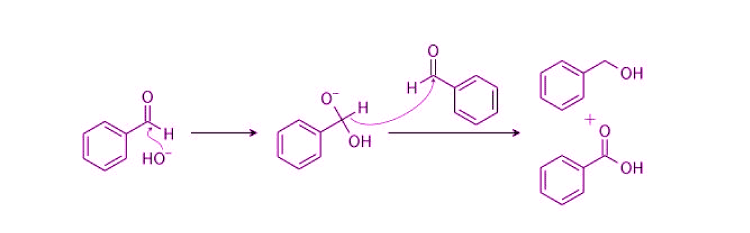
Cannizzaro Reaction Mechanism details the method to get one molecule of alcohol and one molecule of carboxylic acid from two molecules of a given aldehyde. Scientist Stanislao Cannizzaro, in 1853 succeeded in obtaining benzyl alcohol and potassium benzoate from benzaldehyde. The reaction is executed by a nucleophilic acyl substitution on an aldehyde where the leaving group attacks another aldehyde. A tetrahedral intermediate results from the attack of hydroxide on a carbonyl. This tetrahedral intermediate collapses, thereby reforming the carbonyl and transferring a hydride which attacks another colony.
Now, a proton is exchanged by acid and alkoxide ions. When a base of high concentration is introduced, the aldehyde forms an anion which has a charge of 2. From this, a hydride ion is transferred to a second molecule of the aldehyde, forming carboxylate and alkoxide ions. The alkoxide ion also obtains a proton from the solvent for the reaction.