The rate of reaction refers to the speed at which the products are formed from the reactants in a chemical reaction. It gives some insight into the time frame under which a reaction can be completed. For example, the reaction rate of the combustion of cellulose in fire is very high and the reaction is completed in less than a second.
What is Reaction Rate?
The rate of reaction or reaction rate is the speed at which reactants are converted into products. When we talk about chemical reactions, it is a given fact that rate at which they occur varies by a great deal. Some chemical reactions are nearly instantaneous, while others usually take some time to reach the final equilibrium.
This article aims to help students learn about and understand what exactly is the rate of reaction for a given chemical compound.
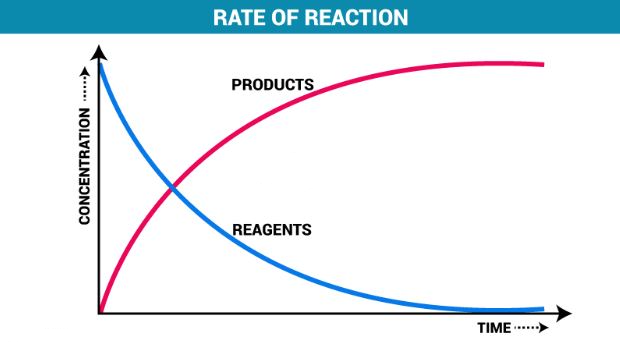
As per the general definition, the speed with which a reaction takes place is referred to as the rate of a reaction.
For example, wood combustion has a high reaction rate since the process is fast and rusting of iron has a low reaction rate as the process is slow.
Factors Affecting the Rate of Reaction
The various factions that can affect the rate of a chemical reaction are listed in this subsection.
Nature of the reaction
- The rate of reaction highly depends on the type and nature of the reaction. As mentioned earlier, few reactions are naturally faster than others while some reactions are very slow.
- The physical state of reactants, number of reactants, complexity of reaction and other factors highly influence the reaction rate as well.
- The rate of reaction is generally slower in liquids when compared to gases and slower in solids when compared to liquids. Size of the reactant also matters a lot. The smaller the size of reactant, the faster the reaction.
Effect of concentration on reaction rate
- According to the collision theory, the rate of reaction increases with the increase in the concentration of the reactants.
- As per the law of mass action, the chemical reaction rate is directly proportional to the concentration of reactants.
- This implies that the chemical reaction rate increases with the increase in concentration and decreases with the decrease in the concentration of reactants.
- Time plays a major role in changing the concentration of reactants and products. Therefore, even time is a vital factor affecting the reaction rate.
Pressure factor
- Pressure increases the concentration of gases which in turn results in the increase of the rate of reaction. The reaction rate increases in the direction of less gaseous molecules and decreases in the reverse direction.
- Thus, it can be understood that pressure and concentration are interlinked and that they both affect the rate of reaction.
How does temperature affect the reaction rate?
- According to collision theory, a chemical reaction that takes place at a higher temperature generates more energy than a reaction at a lower temperature.
- This is because colliding particles will have the required activation energy at high temperature and more successful collisions will take place.
- There are some reactions that are independent of temperature. Reactions without an activation barrier are examples of chemical reactions that are independent of temperature.
Solvent
The rate of reaction also depends on the type of solvent. Properties of solvent and ionic strength highly affect the reaction rate.
Order
The order of reaction manages how the reactant pressure or concentration affects the rate of reaction.
Electromagnetic Radiation
Electromagnetic radiation is a form of energy and its presence at the chemical reaction may increase the rate of reaction as it gives the particles of reactants more energy.
Intensity of Light
Even the intensity of light affects the rate of reaction. Particles absorb more energy with the increase in the intensity of light thereby increasing the rate of reaction.
Presence of Catalyst
- A catalyst can be defined as a substance that increases the rate of the reaction without actually participating in the reaction. The definition itself describes its effect on chemical reactions.
- The presence of a catalyst increases the speed of reaction in both forward and reverse reaction by providing an alternate pathway which has lower activation energy.
Surface Area of the Reactants
The surface area of reactants affects the rate of reaction. If the size of a particle is small, the surface area will be more and this increases the speed of heterogeneous chemical reactions.
Rate of Reaction Formula
Let’s take a traditional chemical reaction.
a A + b B → p P + q Q
Capital letters (A&B) denote reactants and the (P&Q) denote products, while small letters (a,b,p,q) denote Stoichiometric coefficients.
As per IUPAC’s Gold Book, the rate of reaction r occurring in a closed system without the formation of reaction intermediates under isochoric conditions is defined as:

Here, the negative sign is used to indicate the decreasing concentration of the reactant.