What is Phosphoric Acid?
Orthophosphoric acid refers to phosphoric acid. Phosphoric Acid is a weak acid with chemical formula H3PO4.
Phosphoric Acid is an acid-containing four atoms of oxygen, one atom of phosphorus, and three atoms of hydrogen. It is also known as phosphoric(V) acid or orthophosphoric acid. It is present in teeth and bone and helps in metabolic processes. In its liquid form, it appears as a clear, colourless solution and in its solid form, it appears as transparent, crystalline solid.
As a sequestering agent, it helps in the binding of divalent cations. It is widely used in orthodontics and dentistry. Phosphoric acid is important in biogeochemistry and biochemistry. It is a tribasic acid. All three hydrogens are acidic, the pKa value of first , second and third hydrogen are respectively pKa1 = 2.14, pKa2 = 7.20, and pKa3 = 12.37
Structure of Phosphoric Acid (H3PO4)
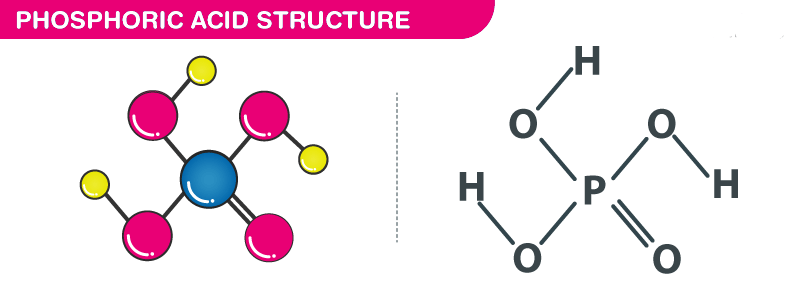
Structure of phosphoric acid
Physical Properties of Phosphoric Acid (H3PO4)
| H3PO4 | Phosphoric Acid |
| Molecular Weight/ Molar Mass | 97.994 g/mol |
| Density | 1.88 g/cm³ |
| Boiling Point | 158 °C |
| Melting Point | 42.35 °C |
- Phosphoric acid is an odourless, colourless, viscous liquid, possessing in a high degree the property of reddening litmus. It cannot be obtained free from water.
- When exposed to a red heat and afterward cooled it forms a transparent brittle glass.
- This fusion should be effected in a platinum crucible since phosphoric acid when heated to redness attacks either glass or porcelain.
- The acid if examined after this exposure to heat is found although its composition remains the same to have acquired new properties.
- On this account the name of para phosphoric has been given to it; while the term phosphoric is applied to designate the acid in the state first described.
- Nitrate of silver yields with phosphoric acid a yellow precipitate with para phosphoric acid a white one. Albumen is coagulated by the latter but not by the former.
Preparation of Phosphoric acid
It can be conveniently prepared by dissolving P2O5 in water followed by boiling the solution to form a thick syrup.
P2O5 + 3H2O → 2H2PO4
Red phosphorus when heated with conc.HNO3 yields orthophosphoric acid.
P + 5HNO3 → H3PO4 + H2O + 5NO2
On a large scale, it is prepared by treating phosphorite rock with dil.H2SO4.
Ca3(PO4)2 + 3H2SO4 → 3CaSO4 + 2H3PO4
Synthesis of Phosphoric Acid – H3PO4
- Phosphoric acid may be obtained by adding sulphuric acid to the phosphate of baryta suspended in water.
- The sulphuric acid unites with the baryta forming an insoluble salt which precipitates while the phosphoric acid remains in solution.
- When phosphorus is gradually added to nitric acid, phosphoric acid is generated and remains mingled with the residual nitric acid.
Chemical Properties of Phosphoric Acid (H3PO4)
- Phosphoric acid is a deliquescent solid, generally encountered as a viscous aqueous solution.
- It is weakly acidic, with three possible sequential deprotonation steps, forming phosphates.
- Like carboxylic acids, phosphoric acid can dimerize via a dehydration reaction to form phospho anhydrides.
- Phosphoric acid is referred to as being tribasic, in that it has three possible dissociation steps.
- As a result mono and disodium and potassium salts of phosphoric acid are routinely used as pH buffers.
- One of the most important reactions of phosphoric acid and its derivatives is multimerization.
- As with carboxylic acids, two phosphoric acid molecules may combine with the loss of water to form a di phosphate ester also referred to as pyrophosphate.
- However, as phosphoric acid has further -OH functionalities triphosphates may also be formed.
- Salts of phosphoric acid are solid and many are relatively water-insoluble unless a strong mineral acid is present.
Basicity of Orthophosphoric Acid (H3PO4)
The basicity of acids is represented by the number of hydrogen atoms which can be replaced by electro – positive atoms. Basicity of an acid is the number of hydrogen ions that can be produced by the ionization of one molecule of the acid in its aqueous solution.
An acid which produces three hydrogen or hydronium ions by the ionization of one molecule of the acid, is called a tribasic acid or tri protic acid. For example, H3PO4 and H3PO3 are tribasic acids.
| Acid | Basicity |
| Hypophosphorous acid (H3PO2) | Oxidation number of Phosphorus = +1Basicity = 1 |
| Phosphorus acid (H3PO3) | Oxidation number of Phosphorus = +3Basicity = 2 |
| Orthophosphoric acid (H3PO4) | Oxidation number of Phosphorus = +5Basicity = 3 |
| Pyrophosphoric acid (H4P2O7) | Oxidation number of Phosphorus = +5Basicity = 4 |
| Metaphosphoric acid (HPO3) | Oxidation number of Phosphorus = +5Basicity = 1 |
Uses of Phosphoric Acid (H3PO4)
Phosphoric acid (H3PO4) has many essential applications, in particular in the manufacture of fertilizers. Many acids are derived from phosphate rocks by a wet process based on the reaction between phosphate rocks and acid solutions.1 This acid (H3PO4) is a medium-strong acid, but is also highly corrosive to ferrous or ferrous alloys.
- It is used as fertilizers – around 90% of phosphoric acid produced is used as fertilizers
- It is used in as a supplement feed for pigs, cattle, poultry
- It is used in skincare products, cosmetics as a pH adjuster
- It is used in brewing, food and dairy industries as a sanitizing agent
- It is used in beverages and food like jam and cola to acidify them
- It is used to remove rust from the surface to metals
Health Hazard
Phosphoric acid is less corrosive and hazardous than is concentrated sulphuric or nitric acid. Its concentrated solutions are irritants to the skin and mucous membranes. The vapours contain P2O5 fumes can cause irritation to the throat and coughing but could be tolerated at <10mg/m3.
Phosphoric acid is a noncombustible substance in both solid and liquid forms. It may be fatal if inhaled. Fumes from fires are irritating to respiratory passages, eyes, skin, and may contain phosphine, phosphoric acid, hydrogen chloride.