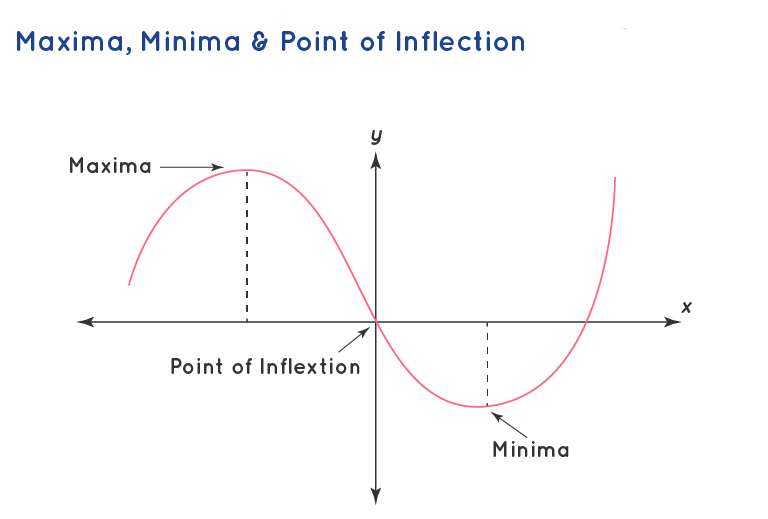
Application of derivatives is also helpful in finding the maxima, minima, and point of inflection of a curve. Maxima and minima are the peaks and valleys of a curve, whereas the point of inflection is the part of the curve where the curve changes its nature(from convex to concave or vice versa). We can find the maxima, minima, and point of inflection by using the first-order derivative test. According to this test, we first find the derivative of the function at a given point and equate it to 0, i.e., f'(c) = 0, (here we have found the slope of the curve equal to 0, which means it is a line parallel to the x-axis). Now if the function is defined in the given interval, then we check the value of f'(x) at the points lying to the left of the curve and to the right of the curve and check the nature of the f'(x), then we can say, that the given point is maxima or minima based on the below conditions.
- Maxima when the slope or f’(x) changes its sign from +ve to -ve as we move via point c. And f(c) is the maximum value.
- Minima when the slope or f’(x) changes its sign from -ve to +ve as we move via point c. And f(c) is the minimum value.
- Point C is called the Point of inflection when the sign of slope or sign of the f’(x) doesn’t change as we move via c.