Isotopes are defined as the atoms of the same element, having the same atomic number ( number of protons ) but different mass numbers ( number of protons+neutrons ).
For example: In the case of Hydrogen we have: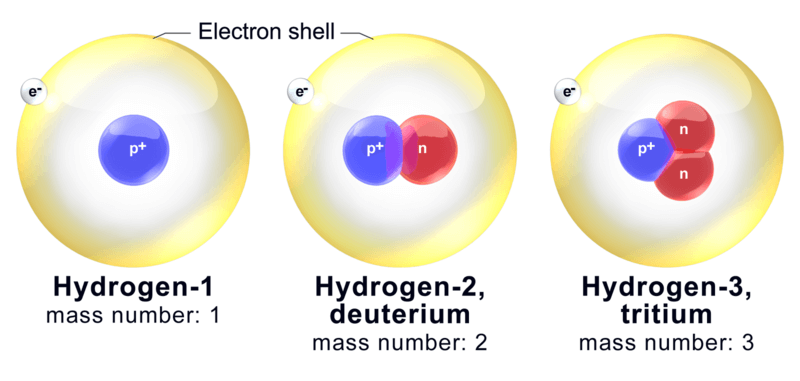
Atoms of different elements with different atomic numbers, which have the same mass number, are known as isobars.
For example, Calcium and Argon: both have the same mass number – 40
20Ca40 and 18Ar40
Calculation of mass number for isotopic elements
When an element has an isotope, the mass number can be calculated by the different proportions it exists in.
For example take 98% Carbon-12u and 2% Carbon-13u
This does not mean that any Carbon atoms exists with the mass number of 12.02u. If you take a certain amount of Carbon, it will contain both isotopes of Carbon, and the average mass is 12.02 u.