Children’s deciduous teeth are also called baby, milk or primary teeth. They are the first set of teeth we receive and will eventually fall out and be replaced with a second set.
When do the first teeth start coming through?
Primary teeth start to form when the baby is in the womb, but start to come through the gums (erupt) when the child is between 6 – 12 months old. Children should have their complete set by 3 years old.
Teeth tend to erupt in parallel, so for example the top molar on the left side should grow in at about the same time as the top molar on the right.
How many teeth do children have, and what are their different types and functions?
The primary set of teeth consists of 20 teeth.
These are made up of: four incisors, two canines and four molars in each jaw.
Incisors bite pieces of food, canines hold and tear food apart and molars grind food.
The diagram below shows where the teeth grow in the mouth:
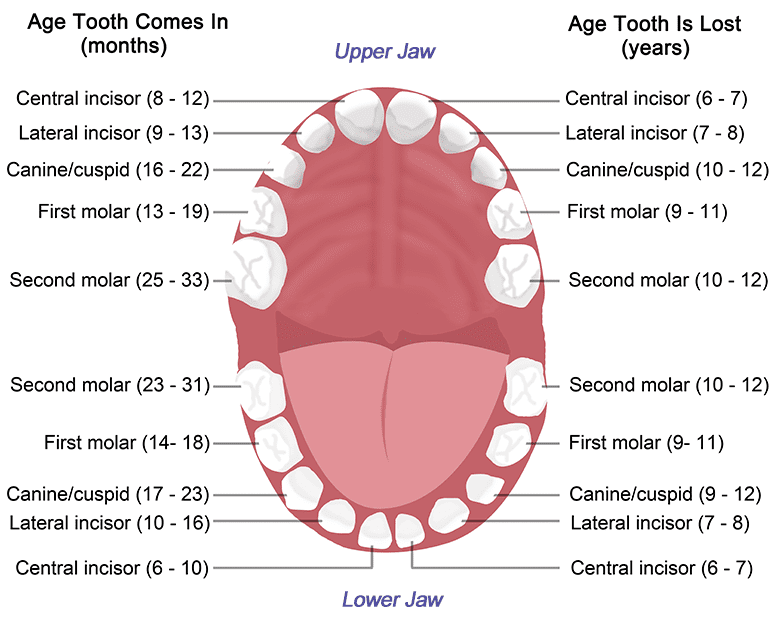
In adult dentition (the second set of teeth) the 8 primary molars are replaced by the premolar (or bicuspid) teeth. The 12 adult molars erupt (grow up from the gums) behind the primary teeth and do not replace any; giving a total of 32 teeth. The adult dentition is therefore made up of four incisors, two canines, four premolars and six molars in each jaw.
When do children start losing their primary teeth?
Primary teeth are usually replaced by adult teeth between the ages of 6 and 12.
How are primary teeth different from permanent (adult) teeth?
Primary teeth are smaller, have more pointed cusps and are a whiter colour than permanent teeth. They also have thinner enamel and dentine so are more prone to wear, and have relatively large pulp chambers and small delicate roots.