Adult teeth are also called permanent or secondary teeth.
When do permanent teeth start coming through (erupting)?
Primary (baby) teeth are usually replaced by adult teeth between the ages of 6 and 12. By 12 years of age, most children should have a full set of permanent teeth, except for wisdom teeth.
Teeth tend to erupt in parallel, so for example, the top molar on the left side should grow in at about the same time as the top molar on the right.
How many teeth do we have, and what are their different types and functions?
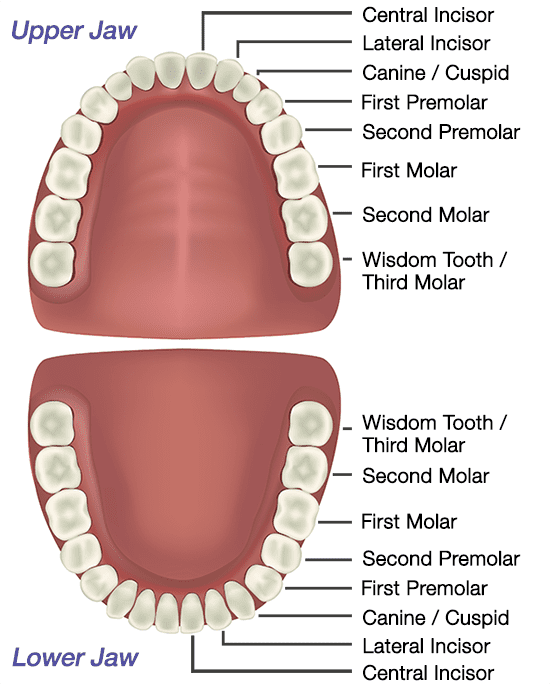
The permanent dentition consists of 32 teeth. This is made up of four incisors, two canines (or cuspids), four premolars (or bicuspids), four molars and two wisdom teeth (also called third molars) in each jaw. If wisdom teeth have been removed there will be 28 teeth.
The incisors are the middlemost four teeth on the upper and lower jaws. They are used for cutting, tearing and holding food. The biting section of an incisor is wide and thin, making a chisel-shaped cutting edge.
The canines (or cuspids, meaning a tooth with a single point) are on either side of the incisors. They are for holding and tearing food.
Premolars (bicuspids) and molars have a series of elevations (points or ‘cusps’) that are used for breaking up particles of food. Each premolar generally has two cusps, hence the name bicuspid. They are used for holding and crushing food.
Molars are the flat teeth at the rear of the mouth. Each molar typically has four or five cusps. They are used exclusively for crushing and grinding.
Wisdom teeth are also called third molars. They erupt from the age of 18 onwards but are often surgically removed.
How many roots does each tooth have?
The number of roots for each type of tooth varies. Typically incisors, canines and premolars will have one root whereas molars will have two or three.
What do my teeth look like?
Our diagrams and images below will show you what the crown and roots of your Incisor, Canine (Cuspid), Premolar (Bicuspid) and Molar teeth look like in each jaw: