The base has a bitter taste and a slippery texture. A base dissolved in water is called an alkali. When chemically reacting with acids, such compounds produce salts. Bases are known to turn blue on red litmus paper.
Base+metal → salt+hydrogen
2NaOH(aq)+Zn(s) → Na2ZnO2(aq)+H2(g)
2NaOH(aq)+2Al(s)+2H2O(l) → 2NaAlO2(aq)+2H2(g)
Extraction of Metals and Non-Metals
Applications of Displacement Reaction
Uses of displacement reaction
- Extraction of metals
- Manufacturing of steel
- Thermite reaction: Al(s)+Fe2O3(s) → Al2O3+Fe(molten)
The thermite reaction is used in welding of railway tracks, cracked machine parts, etc.
Occurrence of Metals
Most of the elements, especially metals occur in nature in the combined state with other elements. All these compounds of metals are known as minerals. But out of them, only a few are viable sources of that metal. Such sources are called ores.
Au, Pt – exist in the native or free state.
Extraction of Metals
The process of extracting metal ores buried deep underground is called Mining. The metal ores are found in the earth’s crust in varying abundance. The extraction of metals from ores is what allows us to use the minerals in the ground! The ores are very different from the finished metals that we see in buildings and bridges. Ores consist of the desired metal compound and the impurities and earthly substances called Gangue.
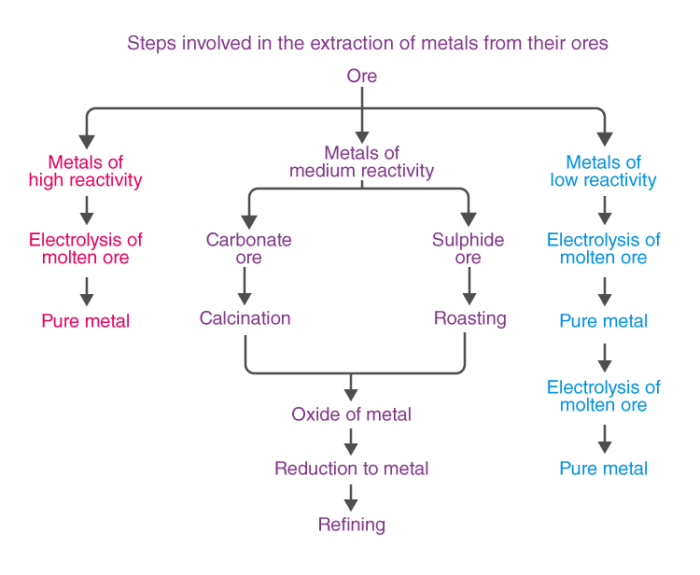
Metals of high reactivity – Na, K, Mg, Al.
Metals of medium reactivity – Fe, Zn, Pb, Sn.
Metals of low reactivity – Cu, Ag, Hg
Enrichment of Ores
It means the removal of impurities or gangue from ore, through various physical and chemical processes. The technique used for a particular ore depends on the difference in the properties of the ore and the gangue.
In chemistry, a gangue is an undesirable substance or impurity that surrounds the mineral in an ore deposit, such as sand, rock, or any other material. When it comes to mining, this mineral is very frequent.
Extracting Metals Low in Reactivity Series
By self-reduction- when the sulphide ores of less electropositive metals like Hg, Pb, Cu etc., are heated in air, a part of the ore gets converted to oxide which then reacts with the remaining sulphide ore to give the crude metal and sulphur dioxide. In this process, no external reducing agent is used.
1. 2HgS(Cinnabar)+3O2(g)+heat→2HgO(crude metal)+2SO2(g)
2HgO(s)+heat→2Hg(l)+O2(g)
2. Cu2S(Copperpyrite)+3O2(g)+heat→2Cu2O(s)+2SO2(g)
2Cu2O(s)+Cu2S(s)+heat→6Cu(crude metal)+SO2(g)
3. 2PbS(Galena)+3O2(g)+heat→2PbO(s)+2SO2(g)
PbS(s)+2PbO(s)→2Pb(crudemetal)+SO2(g)