Orbits are energy shells surrounding the nucleus in which electrons revolve.
Electron distribution in different orbits
The distribution was suggested by Bohr and Bury;
- The maximum number of electrons present in a shell is given by the formula 2n2, where ‘n’ is the orbit number or energy level index, 1,2,3,….
- The maximum number of electrons in different shells are as follows: the first orbit will have 2*12=2, the second orbit will have 2*2Msup>2=8, the third orbit will have 2*32=18, fourth orbit 2*42=32 and so on.
- The shells are always filled in a step-wise manner from the lower to higher energy levels. Electrons are not filled in the next shell unless previous shells are filled.
Valency
- The electrons present in the outermost shell of an atom are known as the valence electrons.
- The combining capacity of the atoms or their tendency to react and form molecules with atoms of the same or different elements is known as valency of the atom.
- Atoms of elements, having a completely filled outermost shell show little chemical activity.
- Their combining capacity or valency is zero.
- For example, we know that the number of electrons in the outermost shell of hydrogen is 1, and in magnesium, it is 2.
- Therefore, the valency of hydrogen is 1 as it can easily lose 1 electron and become stable.
- On the other hand, that of magnesium is 2 as it can lose 2 electrons easily and also attain stability.
Atomic Number
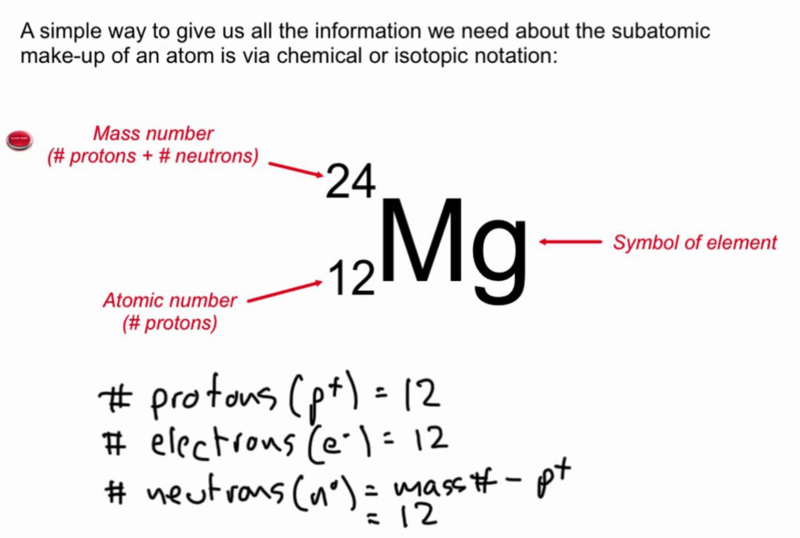
The number of protons found in the nucleus of an atom is termed as the atomic number. It is denoted by the letter ‘Z’.
Mass number and representation of an atom
Protons and neutrons are present in the nucleus, so the mass number is the total of these protons and neutrons.