To understand this mechanism, let us consider the same example illustrated earlier, i.e. the addition reaction of hydrobromic acid with propene. The Mechanism of Markovnikov’s rule can be broken down into the following two steps.
Step 1
The alkene is protonated and it gives rise to the more stable carbocation as shown below.
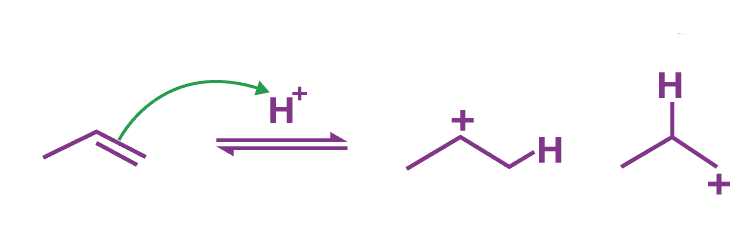
From the illustration shown above, we can see that there are two types of carbocations that can be formed from the protonation of the alkene, one is a primary carbocation and the other is a secondary carbocation. However, the secondary carbocation is far more stable and therefore, its formation is preferred over the formation of a primary carbocation.
Step 2
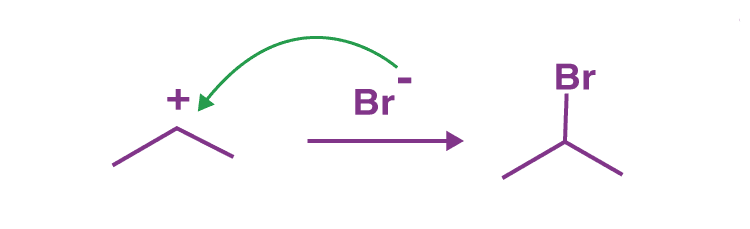
The halide ion nucleophile now attacks the carbocation. This reaction yields the alkyl halide. Since the formation of the secondary carbocation is preferred, the major product of this reaction would be 2-bromopropane as illustrated below.
It is important to note that Markovnikov’s rule was developed specifically for its application in the addition reaction of hydrogen halides to alkenes. The opposite of ‘Markovnikov’ addition reactions can be described as Anti-Markovnikov based on the regioselectivity of the reaction.