A surjective function is defined between set A and set B, such that every element of set B is associated with at least one element of set A. The domain and range of a surjective function are equal.
Let us learn more about the surjective function, along with its properties and examples.
What Is a Surjective Function?
Surjective function is defined with reference to the elements of the range set, such that every element of the range is a co-domain. A surjective function is a function whose image is equal to its co-domain. Also, the range, co-domain and the image of a surjective function are all equal. Additionally, we can say that a subjective function is an onto function when every y ∈ co-domain has at least one pre-image x ∈ domain such that f(x) = y. Let’s go ahead and explore more about surjective function.
A function ‘f’ from set A to set B is called a surjective function if for each b ∈ B there exists at least one a ∈ A such that f(a) = b. None of the elements are left out in the onto function because they are all mapped from some element of set A. Consider the example given below:
Let A = {a1, a2, a3 } and B = {b1, b2 } then f : A →B.:{(a1, b1), (a2, b2), (a3, b2)}
Here in the above example, every element of set B has been utilized, and every element of set B is an image of one or more than one element of set A.
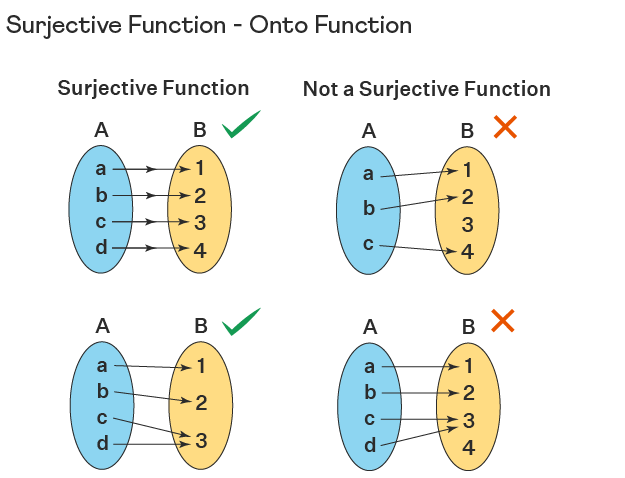
In the above examples of functions, the functions which do not have any remaining element in set B is a surjective function. In a surjective function, every element of set B has been mapped from one or more than one element of set A. Also, the functions which are not surjective functions have elements in set B that have not been mapped from any element of set A.
Properties of Surjective Function
A function is considered to be a surjective function only if the range is equal to the co-domain. Here are some of the important properties of surjective function:
- In a surjective function, every element in the co-domain will be assigned to at least one element of the domain.
- The co-domain element in a subjective function can be an image for more than one element of the domain set.
- In a subjective function, the co-domain is equal to the range.A function f: A →B is an onto, or surjective, function if the range of f equals the co-domain of the function f.
- Every function that is a surjective function has a right inverse. Also, every function which has a right inverse can be considered as a surjective function.