Salts are chemical compounds made by the reaction between acids and bases. When an acid reacts with a base, a salt is formed. Salts have characteristic and consistent properties different from their ingredient elements. They are ionic compounds, made of metal cations and organic or inorganic anions. Hence, they are generally soluble in water. They are classified based on their nature as acidic salts, basic salts, and neutral salts.
Types of salts
Salts are ionic compounds usually obtained by neutralization reactions. They are generally neutral compounds but some of them are acidic and basic in their solution form. This concept was explained by Bronsted-Lowry. It states that ions can act either as an acid or a base. So, the acidity or basicity of salts depends upon the type of cations and anions produced in the solution.
The common types of salts are acid, basic, neutral, double, and complex salts.
Acidic salts
Ammonium chloride solution is acidic in nature because of the acidic nature of ammonium (NH4+) ions.
NH4+ + H2O → NH3 + H3O+
Here ammonium ions act as an acid and donate a proton to H2O resulting in H3O+.
Basic Salts
Sodium cyanide is a basic salt. Upon its addition to water, it hydrolyzes into its ions.
NaCN → Na+ + CN–
CN– + H2O → HCN + OH–
Sodium ions are not reactive while CN– ions react with H2O to form OH– ions. By the Lowry-Bronsted concept, cyanide ion is a base as it accepts a proton. This is why NaCN is a basic salt.
Neutral salts
Some salts produce ions on hydrolysis which do not react with water to produce hydronium ions or hydroxyl ions. For example, NaCl is soluble in water. It gives Na+ and Cl– ions. Both these ions are unreactive to species present inside water.
Cl– + H2O → no reaction
Na+ + H2O → no reaction
Double salts
Double salts contain more than one cation. They occur naturally and are found in the earth’s mantle. For example:
- Mohr’s salt, (NH4)2 Fe(SO4)2.6H2O
- Tutton’s salt, K2Cd (SO4)2.6H2O, etc.
Complex salts
The coordination compounds are sometimes referred to as complex salts. This is because they contain transition metal atoms as cations. The “complex” word describes the varying valencies of the transition metals. In such complexes, cations are in the center surrounded by anions and ligands to form complexes.
Some properties of salts
Salts in chemistry are studied according to their properties. Among these properties are solubility, brittleness, high melting and boiling points, and conductivity of salts.
Solubilities
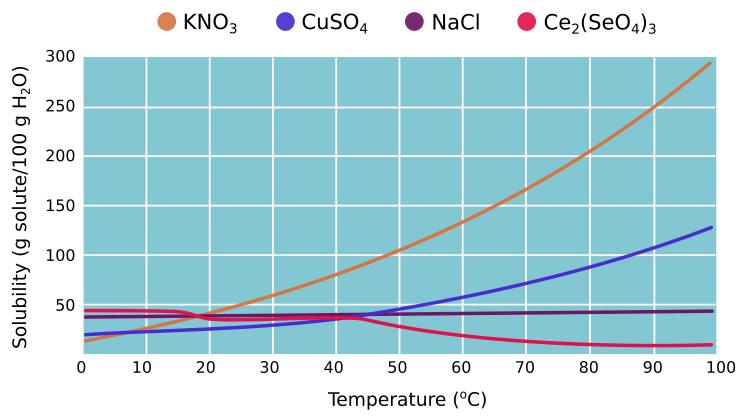
Salts are usually ionic in nature, therefore, most of them are soluble in water. For sparingly soluble, a concept of solubility product (Ksp) is used. The solubility of some salts is given in the illustration below:
Brittle nature
Salts are ionic compounds. Positive and negative charges are arranged to form unit cells. When hammered, the layers displace from above causing opposite charges in front of each other, and thus a crystal breaks apart. This brittle nature of salts also explains why these compounds are hard and exist in the form of crystalline solids.
Melting and boiling points
Salts are giant ionic lattices which is why they have high melting and boiling points. For example:
- Sodium chloride (NaCl) melts at 801 °C and boils at 1413°C.
- Magnesium oxide (MgO) melts at 2852 °C and boils at 3600 °C.
- Barium chloride (BaCl2) melts at 961 °C and boils at 1560 °C.
Conductivity
Salts are good conductors of electricity in molten and aqueous states. Their conductivity is due to the presence of electrostatic charges and electrons that can flow upon application of external force. So, the conductivity of salts depends upon their solubility or ionic nature.