
Ingredients : 2 (30 g) scallions, finely chopped 140 g cooked bacon or salami, chopped 12 eggs 2 tbsp red pesto or green pesto (optional) salt and pepper, to taste 350 ml (170 g) shredded cheddar cheese Instructions : Preheat the oven to 350°F (175°C). Line a muffin tin with paper baking cups, grease a silicone muffin tin with butter, or use a non-stick… Continue reading Keto egg muffins
Month: September 2022
keto meatballs with mozzarella cheese (Italian)

Ingredients : 450 g ground beef or ground turkey 180 ml (60 g) shredded Parmesan cheese 1 egg 1 tsp salt ½ tbsp dried basil ½ tsp onion powder 1 tsp garlic powder ½ tsp ground black pepper 3 tbsp olive oil 425 ml (425 g) canned whole tomatoes 2 tbsp fresh parsley, finely chopped 200 g (1.6 liters) fresh spinach 55 g butter 140 g (300 ml) fresh mozzarella cheese salt and… Continue reading keto meatballs with mozzarella cheese (Italian)
BLTA Lettuce Wraps
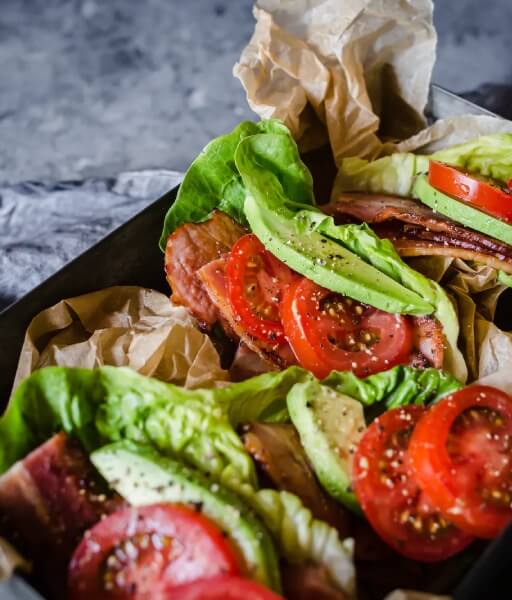
Ingredients : 170 g bacon in slices 3 tbsp mayonnaise 55 g (350 ml) lettuce (2 leaves per serving) ½ (100 g) avocado 1 (110 g) tomato, in slices salt and pepper Instructions : In a large skillet over medium heat, fry the bacon until crispy, about 5 minutes. Set aside on a paper towel–lined plate to cool. When cool enough to handle,… Continue reading BLTA Lettuce Wraps
Keto Egg Muffins

Ingredients : 2 (30 g) scallions, finely chopped 140 g cooked bacon or salami, chopped 12 eggs 2 tbsp red pesto or green pesto (optional) salt and pepper, to taste 350 ml (170 g) shredded cheddar cheese Instructions : Preheat the oven to 350°F (175°C). Line a muffin tin with paper baking cups, grease a silicone muffin tin with butter, or use a non-stick… Continue reading Keto Egg Muffins
HTML Introduction
HTML (HyperText Markup Language) is a primary markup language for creating websites. It consists of a series of codes used to structure texts, images, and other content to be displayed in the browser. HTML Versions HTML was first developed by British physicist Tim Berners-Lee in 1990. Since that time, there have been many versions of HTML. Version… Continue reading HTML Introduction
Example 3:
Example 3: A force of 11 pounds and a force of 6 pounds act on an object at an angle of 41° with respect to one another. What is the magnitude of the resultant force, and what angle does the resultant force form with the 11‐pound force (Figure 7)? Figure 7 … Continue reading Example 3:
Example 2 :
Example 2: A plane flies at 300 miles per hour. There is a wind blowing out of the southeast at 86 miles per hour with a bearing of 320°. At what bearing must the plane head in order to have a true bearing (relative to the ground) of 14°? What will be the plane’s groundspeed (Figure… Continue reading Example 2 :
Vector Operations
In the physical world, some quantities, such as mass, length, age, and value, can be represented by only magnitude. Other quantities, such as speed and force, also involve direction. You can use vectors to represent those quantities that involve both magnitude and direction. One common use of vectors involves finding the actual speed and direction… Continue reading Vector Operations
Examples
Example 4: Find a unit vector v with the same direction as the vector u given that u = ⟨7, − 1⟩. Two special unit vectors, i = ⟨1, 0⟩ and j = ⟨0, 1⟩, can be used to express any vector v = ⟨a, b⟩. Example 5: Write u = ⟨5, 3⟩ in terms of the i and j unit vectors (Figure 5 ). Figure 5 Drawing for Example 5.… Continue reading Examples
Coordinate System 2
Figure 2 Drawing for Example 1. If the coordinates of point P are ( x, y), An algebraic vector is an ordered pair of real numbers. An algebraic vector that corresponds to standard geometric vector is denoted as ⟨ a, b⟩ if terminal point P has coordinates of (a, b). The numbers a and b are called the components of vector ⟨ a, b⟩ (see Figure… Continue reading Coordinate System 2